The driver who pulled out in front of you has up to $40,000 in no-fault benefits waiting on their own policy, whether the crash was their fault or not. You have none. That gap is written into Minnesota law, and most riders find out about it from a hospital billing department.
Our Minneapolis motorcycle accident lawyers at Tyroler Leonard Injury Law build claims for riders across Hennepin County and the west metro. We start from the assumption that the insurance company will try to make this your fault.
Call +1 (952) 567-2488 for a free case review. Someone answers 24/7.
Table of contents
- Does Minnesota No-Fault Insurance Cover Motorcycle Riders?
- Does Medical Payments Coverage Pay Your Bills After a Motorcycle Crash?
- Who Pays Your Medical Bills After a Minneapolis Motorcycle Crash?
- What If the Insurance Company Says the Crash Was Your Fault?
- Minneapolis Road Conditions That Keep Showing Up in Rider Claims
- What Are Motorcycle Injury Claims Worth in Minnesota?
- Does the Insurance Company Have to Pay for Your Bike and Your Gear?
- What Happens in the First Month of a Motorcycle Claim?
- Why Riders Work With Tyroler Leonard Injury Law
- Minneapolis Motorcycle Accident Questions Riders Actually Ask
- Ride Now, Argue Later Is Not a Legal Strategy
Does Minnesota No-Fault Insurance Cover Motorcycle Riders?
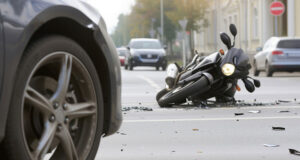
No. Minnesota's No-Fault Act does not apply to motorcycles, so a rider gets no automatic medical or wage benefits after a crash. The statute defines a "motor vehicle" as a vehicle "other than a motorcycle or other vehicle with fewer than four wheels" (Minn. Stat. 65B.43). Motorcycles were written out of the definition, which means they were written out of the benefits.
For a driver in a car, this is invisible. Their own insurer pays the first $20,000 of medical bills and up to $20,000 in wage loss and related costs under Minn. Stat. 65B.44, no fault questions asked.
For you, nothing starts automatically. Every dollar has to come from proving that someone else caused the crash.
| Car occupant in Minnesota | Motorcycle rider in Minnesota | |
|---|---|---|
| Automatic medical coverage | Up to $20,000 in PIP, the personal injury protection built into every Minnesota auto policy | None |
| Automatic wage loss coverage | Up to $20,000 combined | None |
| Who pays the first ER bill | Your own auto insurer | Health insurance, or you |
| Must prove another driver was at fault | No, to access those benefits | Yes, from day one |
| Health insurer reimbursement claim | Usually avoided | Common, and negotiable |
The health insurance piece matters more than riders expect. When a health plan covers your trauma care, it often has a right to be paid back out of your settlement. Reducing that repayment is real money, and it is part of what our lawyers handle rather than something you should be negotiating from a recliner with a fixator on your leg.
Does Medical Payments Coverage Pay Your Bills After a Motorcycle Crash?
It can, if you added it to your motorcycle policy. Medical payments coverage, often called MedPay, is optional coverage that pays your own medical bills after a crash no matter who caused it. For a Minnesota rider, it is the closest thing to the no-fault benefits drivers get automatically.
It is not part of a basic motorcycle policy. The Minnesota Department of Commerce explains that a basic motorcycle policy does not include personal injury protection, and that the PIP on your car policy will not cover you while you are on your motorcycle.
Coverage for your own injuries has to be added to the motorcycle policy itself. Depending on the insurer, it is sold as MedPay or as a PIP-style add-on, called an endorsement.
Many riders do not know whether they bought it. The declarations page, the summary sheet at the front of your policy, will say.
When it is there, it helps in two ways. It does not depend on fault, so it can pay while the other driver's insurer is still arguing that you caused the crash. And depending on the policy terms, it may apply when no other vehicle was involved at all, such as a spill on gravel or a pothole.
Limits are set when the policy is written and are often modest, so MedPay usually covers the early bills rather than the whole claim. Using it does not stop you from pursuing the at-fault driver for the rest of your losses.
Who Pays Your Medical Bills After a Minneapolis Motorcycle Crash?
Usually three sources, in this order: your health insurance, the at-fault driver's liability coverage, and then your own uninsured or underinsured motorist coverage if the driver's policy runs dry. A serious motorcycle injury can blow past a driver's whole policy in the first week, and Minnesota only requires $25,000 per person in uninsured and underinsured motorist coverage (Minn. Stat. 65B.49).
So the question is rarely "who was at fault." It is "how many layers of coverage exist, and did anyone look for all of them."
Two of those sources are commonly missed in rider claims.
Your own uninsured and underinsured motorist coverage, shortened to UM and UIM, applies even though you were on a bike and even though the crash was not your fault. Riders sometimes assume it is only for hit-and-run cases. It is not.
A resident relative's policy can also come into play depending on the household and the vehicle involved, which is a question worth asking before anyone concludes the money has run out. If your injuries are permanent, our Minnesota catastrophic injury lawyers handle that search across every policy connected to the crash.
Not sure what coverage applies to your crash? Call +1 (952) 567-2488 and we will look at the policies with you before you sign anything.
What If the Insurance Company Says the Crash Was Your Fault?

Partial fault does not end your claim in Minnesota. Under Minn. Stat. 604.01, you can still recover as long as your share of the fault "was not greater than the fault of the person against whom recovery is sought." At 20% fault, you recover 80%. At 51%, you recover nothing.
Adjusters know this, and that is why riders get blamed. Pushing you from 40% to 51% is not a small argument. It is the whole case.
Three blame narratives come up over and over in Twin Cities motorcycle claims.
Can the Insurance Company Use It Against You If You Weren't Wearing a Helmet?
They can try, but Minnesota law is not on their side. The state requires helmets only for riders under 18 and for permit holders, and requires eye protection for everyone (Minn. Stat. 169.974). Riding without a helmet at 25 is legal.
There used to be a provision in that same statute letting defendants put helmet use in front of a jury to cut damages for head injuries. The legislature repealed it in 1999. An adjuster who leads with "well, you weren't wearing a helmet" is making a settlement argument, not a legal one.
Is Lane Splitting Legal in Minnesota?
Yes. Since July 1, 2025, Minnesota allows both lane splitting and lane filtering, with limits.
The Department of Public Safety describes splitting as passing in slow traffic at no more than 25 mph and no more than 15 mph over the speed of traffic. Filtering means moving through stopped traffic at no more than 15 mph (DPS Office of Traffic Safety). Neither is allowed in roundabouts, school zones, freeway on-ramps, or work zones narrowed to one lane.
The law is new enough that we still see claim files treating a legal maneuver as reckless riding. Correcting that early, with the traffic data and the rules in writing, keeps a bad assumption from hardening into a low offer.
Why Do Left-Turn Crashes Get Argued So Hard?
Because the only two witnesses usually disagree about speed. A driver turning left across your lane at Lyndale, Hennepin, or a Franklin Avenue intersection almost always says the same thing: the motorcycle came out of nowhere and was going too fast. Speed is the one fact a driver can assert without evidence and an adjuster can adopt without checking.
Event data recorders, signal timing, sight-line measurements, and camera footage from nearby businesses answer it. That evidence has a short shelf life, which is the practical reason to bring lawyers in early rather than after the first denial.
Minneapolis Road Conditions That Keep Showing Up in Rider Claims
Minnesota compresses a full year of riding into roughly five months, so exposure is concentrated in a season when road surfaces are at their worst. Two local realities show up in claims repeatedly.
Spring pavement is not the same pavement drivers remember. Freeze and thaw cycles open potholes and edge cracks across metro arterials, and the sand and grit left from winter treatment sits in exactly the places riders lean. A car crosses that without noticing. A bike does not.
The construction season overlaps the riding season almost perfectly. Steel plates, fresh milling, and loose aggregate at the edge of a paving joint are surface changes a driver in a sedan never registers and a front tire finds immediately. When a work zone contributed, a contractor or a road authority may belong in the claim alongside the driver, which changes who has to be put on notice and how quickly.
Rider cases that reach a courtroom are usually heard in front of Hennepin County jurors. Those jurors drive these same roads, which cuts both ways. They understand the surface conditions, and they also arrive with whatever they already believe about motorcycles. Preparing a case for that room is different from preparing one for a rural county.
What Are Motorcycle Injury Claims Worth in Minnesota?
Value tracks three things: how permanent the injury is, how much coverage exists, and how the fault split lands. There is no formula, and any number given to you before the medical picture is stable is a guess.
What typically drives the number up in rider cases:
- Injuries that do not fully resolve. Hardware that stays in, a fusion, a joint that will need revision, or a traumatic brain injury that changes how you work. Our Minneapolis brain injury lawyers handle the ones where cognition is affected.
- Lost earning capacity, not just lost paychecks. If you cannot go back to the trade you were in, the claim is about the next twenty years, not the last twelve weeks.
- Documented future care. Surgeries planned but not yet done, injections, therapy, and equipment.
- Scarring and degloving injuries. Road rash gets dismissed as a scrape until you see the grafting.
One thing riders often miss: a passenger on the back of your bike has a separate claim, and it is not limited by whatever fault gets assigned to the driver carrying them.
Passenger claims can reach both the at-fault driver's policy and, in some situations, coverage connected to the motorcycle itself. Sorting that out early keeps two people who care about each other from ending up on opposite sides of a claim file.
What holds the number down is almost always one of two things: a coverage ceiling nobody looked past, or a fault percentage nobody fought.
Both are fixable early and very hard to fix late. Once a release is signed, the coverage question closes with it, even if a second policy turns up a month later.
Does the Insurance Company Have to Pay for Your Bike and Your Gear?

Your damaged riding gear is property damage, and it is claimable along with the motorcycle. Helmets, jackets, boots, gloves, and armor take the impact by design, and a set that did its job is often worth more than a rider assumes. Insurers rarely volunteer this, and most riders never submit it.
Two things go wrong on the property side of rider claims.
The first is total loss valuation. Adjusters price motorcycles off comparable listings that ignore what you actually put into the bike. Exhaust, suspension, seat, luggage, engine guards, and paint are frequently left out of the first offer. Receipts and photographs move that number.
The second is timing. Riders sometimes settle the property claim quickly to get a check, then discover the release they signed reached further than the bike. Property damage and injury claims can be resolved separately, and they should be. Read what you are signing, or let our lawyers read it first.
What Happens in the First Month of a Motorcycle Claim?
The first thirty days decide how much evidence you still have. In a typical case, the sequence looks like this.
Week one is preservation. Photographs of the scene and the bike before it is repaired or scrapped, the crash report, the gear as it came off, and notice to every insurer that may be involved.
Week two is coverage. Locating and confirming every applicable policy, including umbrella and commercial layers, and opening the health insurance and reimbursement question before bills go to collections.
Weeks three and four are documentation. Medical records, wage information, and, if the fault story is contested, camera footage requests and witness statements before memories and hard drives turn over.
None of this requires a decision about filing a lawsuit. It requires someone doing it while the evidence is still there.
Why Riders Work With Tyroler Leonard Injury Law

Isaac Tyroler and Rachel Sperling Leonard are licensed in both Minnesota and Wisconsin, and in the federal district courts of both states. That matters on the east metro line, where a Hudson-bound rider can be hurt on either side of the border.
Isaac Tyroler sits on the Board of Governors of the Minnesota Association for Justice and chairs its legislative committee. Rachel Sperling Leonard's practice has centered on motor vehicle and motorcycle injury work for over a decade.
Practical things worth knowing:
- Rider cases are handled on contingency
- Someone is reachable 24/7, including from a hospital room
- We have Spanish-speaking attorneys on staff, not a translation line. Riders who prefer Spanish can start at our abogados de accidentes de motocicleta en Minnesota page
- The filing deadline is 6 years for Minnesota, 3 years for Wisconsin
Talk to our lawyers before you talk to the other driver's adjuster. Call +1 (952) 567-2488.
Minneapolis Motorcycle Accident Questions Riders Actually Ask
How much do motorcycle accident lawyers in Minneapolis cost?
Nothing up front. We work on contingency, which means our fee is a percentage of what we recover and there is no bill if we recover nothing. Case evaluations are free, and you are not committing to anything by asking questions. We will also tell you if we think you do not need lawyers at all.
Should I give the other driver's insurance company a recorded statement?
Not before you have talked to our attorneys. You are not required to give a recorded statement to another driver's insurer, and those calls are not neutral fact gathering. Questions about how fast you were going, whether you saw the car, and how you feel today get quoted back months later against a medical record that has changed.
What happens if the driver who hit me left the scene?
Your own uninsured motorist coverage often becomes the source of recovery in a hit-and-run, even though you were on a motorcycle and even though the other vehicle was never identified. Reporting the crash promptly to law enforcement and to your own insurer protects that claim. Our Minneapolis hit-and-run lawyers handle these.
I felt fine at the scene and declined the ambulance. Do I still have a case?
Often, yes. Adrenaline masks a great deal at a crash scene, and shoulder, wrist, neck, and head injuries commonly announce themselves a day or two later. The gap in treatment becomes an argument the insurer makes, not a bar to your claim. Getting evaluated and being specific with the provider about the crash closes most of that gap.
Do motorcycle cases go to trial, or do they settle?
Most resolve without a trial. What moves a pretrial number, though, is whether the file looks ready for one. Insurers track which firms actually file suit and which firms only negotiate, and they price accordingly.
Ride Now, Argue Later Is Not a Legal Strategy

Riders tend to wait. The bike is in a garage somewhere, the surgeries are scheduled, and dealing with the insurance company feels like something to handle once life settles down. Meanwhile the intersection camera footage overwrites itself, the sand gets swept, the witness moves, and the adjuster builds a file with only the other driver's version in it.
You do not have to be sure you have a case to make the call. Bring us the police report number and whatever you remember, and our lawyers will tell you what the claim looks like and what it does not.
Free case review, no fee unless we recover for you, and someone available 24/7. Call Tyroler Leonard Injury Law at +1 (952) 567-2488, or send us your crash details and we will call you.