In Minnesota, we understand winter. We know the biting cold, the sound of snowplows in the pre-dawn hours, and the treacherous feel of black ice beneath our tires. We accept hazardous roads as a seasonal reality.
But when that reality leads to the screech of metal and a life-altering injury, a dangerous misconception often takes hold: the belief that no one is at fault when the roads are bad.
People call it a "weather-related" accident, as if the snow or ice were the only cause. This is a myth, and it is a myth that insurance companies eagerly exploit. The truth is that drivers have a legal duty to adjust their behavior to match the conditions.
When they fail to do so, they are negligent. This is the foundation of winter car accident claims: what makes them different in Minnesota? is not that the rules of fault are suspended, but that proving fault requires a much deeper investigation into driver behavior and the specific physics of a winter crash. A Plymouth MN car accident lawyer can help identify negligence and prove liability when winter conditions contribute to a serious collision.
Key takeaways
- Bad weather does not excuse negligence. Minnesota law requires drivers to operate their vehicles at a speed reasonable for existing conditions, including snow and ice.
- Proving fault in a winter accident demands a detailed investigation into speed, following distance, tire condition, and whether a driver's actions were appropriate for the weather.
- Minnesota's No-Fault insurance system acts as your primary source for initial medical bills and lost wages, allowing you to get immediate help regardless of who caused the winter crash.
- Chain-reaction pile-ups on icy highways create complex legal challenges. An attorney must investigate every driver's actions to untangle liability and find all sources of compensation.
- Insurance companies often blame the weather to avoid paying claims. You need a strong, evidence-based case to overcome this tactic and hold the negligent driver accountable.
A Driver's Legal Duty in Winter Conditions
The core of any car accident claim is the legal concept of negligence. To recover compensation, you must prove that another driver failed to exercise a reasonable level of care and that failure caused your injuries. In winter, the law applies a stricter definition of "reasonable care."
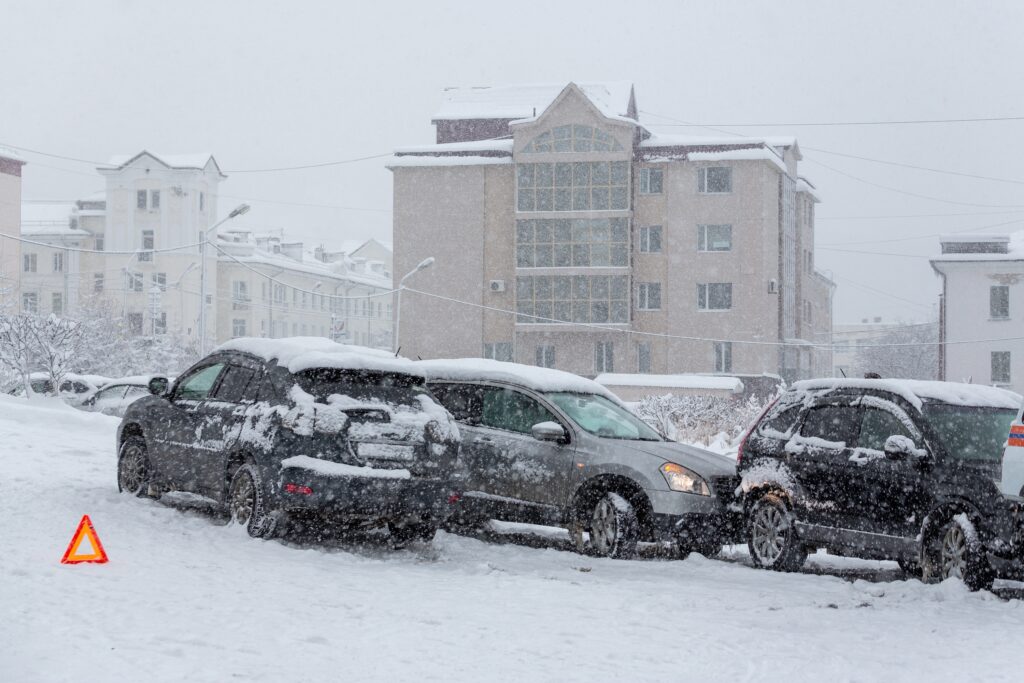
Driving the speed limit on a dry, sunny day might be reasonable. Driving that same speed on an icy road in blowing snow demonstrates a clear act of negligence.
Minnesota's basic speed law
Minnesota's "basic speed law" is a critical component of winter accident claims. As Minnesota Statutes § 169.14 outlines, a driver must always operate their vehicle at a speed that is "reasonable and prudent under the conditions."
The law specifically mentions the need to reduce speed when "special hazards exist...by reason of weather or highway conditions." This means a driver who causes a crash on an icy road while driving the posted speed limit still broke the law because they drove too fast for the conditions.
Investigating Fault on Hazardous Winter Roads
Proving another driver violated their duty of care in a winter crash requires a sophisticated investigation. Simply stating the other driver slid on ice is not enough.
You must prove why they slid. Did they speed, follow too closely, or operate a vehicle unfit for winter driving?
A detailed investigation into a winter accident uncovers the negligent choices that led to the crash.
A legal team will gather evidence to paint a clear picture of the other driver's careless behavior.
- Unreasonable speed. Accident reconstructionists can analyze the crash scene, vehicle damage, and witness statements to determine the other driver's approximate speed and prove it was reckless for the road conditions.
- Unsafe following distance. A driver needs significantly more distance to stop on a slippery surface. A driver who rear-ends another vehicle on an icy road was following too closely to react safely.
- Poor vehicle maintenance. An investigator can examine the other vehicle's tires. If the tires were bald, the driver was negligently operating a vehicle unequipped for Minnesota winter.
- Driver distraction. A driver who texts or looks away from the road has even less time to react to a sudden stop or a patch of black ice, making their distraction a key cause of the crash.
- Disregarding weather warnings. If weather services advised against travel, a driver who chose to be on the road can be held to an even higher standard of care for the risks they took.
These factors combine to prove the driver's negligence. The snow on the road was just a condition; the driver's poor choices caused it.
The Unique Challenge of Black Ice
Black ice is one of Minnesota's most notorious winter hazards because it is invisible. Drivers often do not see it until their vehicle is already sliding out of control. However, the presence of black ice does not automatically give a driver a free pass for causing an accident.
Establishing liability in a black ice crash
Liability in a black ice accident often hinges on the legal concept of foreseeability. When the temperature is near or below freezing, any reasonably prudent Minnesota driver should foresee the potential for black ice, especially on bridges, overpasses, and in shaded areas.
A driver who fails to reduce speed and exercise extreme caution in these known high-risk areas acts negligently. If they lose control and cause a collision, they can be held responsible.
The Legal Chaos of a Multi-Car Pile-Up
Winter conditions frequently cause chain-reaction pile-ups on major highways like I-94 or I-35. These scenarios are legally and factually chaotic. An attorney must untangle the sequence of impacts to determine which driver's negligence is responsible for which injuries.
Tracing the chain of negligence
A pile-up can involve multiple points of impact and multiple negligent drivers. The first driver who lost control and caused the initial blockage may be at fault. Any subsequent driver who followed too closely and could not stop in time is also negligent.
An experienced attorney often hires accident reconstruction experts to analyze the physical evidence, vehicle data, and witness statements to determine each vehicle's role. As an injured person, you may have valid claims against several different drivers, and an attorney must identify all of them to ensure you can be fully compensated.
Minnesota's No-Fault System: Your First Line of Support
Minnesota's No-Fault insurance system provides a vital and immediate safety net in the confusing aftermath of a winter crash. The system gets you help for your initial economic losses without making you wait for the lengthy process of proving fault.
Your PIP coverage is your primary resource
No matter who caused the accident, your own auto insurance policy's Personal Injury Protection (PIP) is your primary source for benefits. Your PIP coverage pays for your initial medical bills and a portion of your lost wages, up to your policy limits.
This allows you to receive the medical treatment you need immediately while your legal team builds the liability case against the at-fault driver.
Stepping outside the no-fault system
You can file a liability claim against the at-fault driver for damages that your PIP benefits do not cover. This includes your pain, suffering, emotional distress, and any economic losses that exceed your PIP limits.
Minnesota law requires that your injuries meet a certain threshold to file this type of claim, such as incurring a specific amount in medical expenses or suffering a permanent injury or disability.
FAQ for Winter Car Accident Claims in Minnesota
We both slid on the ice. Does this mean neither of us is at fault?
No. Insurance companies often use this scenario to declare a "no-fault" situation and deny all claims. However, a thorough investigation can show that one driver's actions were more negligent than the other's.
For example, if one driver was traveling at a much higher speed, had bald tires, or was following too closely, they would likely bear the majority of the fault, even if both vehicles lost traction.
Can I sue the government for not plowing or salting the roads properly?
Suing a government entity for road conditions is exceptionally difficult. In Minnesota, government bodies have "sovereign immunity," which protects them from many lawsuits. While some very narrow exceptions exist, proving that the government's actions were negligent is a very high legal bar to clear.
In most cases, the claim will focus on the negligence of the other drivers who failed to adapt to the existing road conditions.
I was a passenger when my friend lost control and hit a guardrail. Can I file a claim?
Yes. As an innocent passenger, you have a clear right to file a claim. Your claim would be against the driver of the vehicle you were in. Their failure to maintain control of the vehicle, even on an icy road, is a form of negligence. You would file the claim against their auto insurance policy to cover your damages.
The driver who hit me is from Wisconsin. How does that impact my Minnesota accident claim?
The accident is governed by the laws of the state where it happened. Because the crash occurred in Minnesota, Minnesota's No-Fault laws and comparative fault rules apply to the case, no matter where the other driver lives.
Your attorney will file the claim in Minnesota and force the Wisconsin-based insurance company to operate under Minnesota law.
Building a Solid Claim from a Winter Wreck
You should not carry the financial and physical burden of an accident caused by a driver who ignored the dangers of a Minnesota winter. An experienced legal team knows how to conduct the deep investigation needed to prove negligence in winter conditions.

They can uncover the evidence required to fight back against the insurance company's attempts to blame the weather and build a powerful case for the full compensation you need.
The attorneys at Tyroler Leonard Injury Law, Isaac Tyroler and Rachel Sperling Leonard, are lifelong Minnesotans who understand the unique challenges of winter accident claims. A Plymouth MN personal injury lawyer can help ensure that your rights are protected and that fault is properly established.
We represent injured people throughout Minnesota and Wisconsin from our offices in Minneapolis, Oakdale, and Willmar. We have the resources and resolve to prove fault and hold negligent drivers accountable, no matter the road conditions.
Se habla español. Llámenos para una consulta gratuita.
Call our office at (651) 259-1113 or complete our online contact form for a free, no-obligation consultation.