You followed the safety protocols. You wore your gear. You did your job the way you were trained to do it. But another company’s employee, a careless subcontractor, or a faulty piece of equipment changed everything.
You were hurt on the job, but your employer was not the one at fault. Now you are collecting workers’ compensation benefits, but you know they do not even begin to cover the full extent of your losses. You are left with the pain, the financial stress, and the frustrating sense that the party who truly caused your harm is getting away with it.
This is where the concept of third-party liability in workplace accidents in Minnesota becomes so important. It is a separate legal path that allows you to step outside the restrictive workers’ comp system and hold the actual negligent party fully accountable for the damages they caused.
Beyond workers' comp: What to know about third-party claims
- A third-party liability claim is a personal injury lawsuit filed against a person or company—other than your direct employer—whose negligence caused your on-the-job injury.
- This is a separate and additional claim to your workers’ compensation benefits. It allows you to pursue compensation for pain and suffering, which workers’ comp does not cover.
- These claims are common in multi-employer settings like construction sites, where the negligence of one subcontractor often injures an employee of another.
- Proving a third-party claim requires a deep investigation to show that the other party had a duty of care toward you and that their specific breach of that duty was the cause of your accident.
The Limits of Workers' Compensation
The workers' compensation system in Minnesota is a vital safety net. It is a no-fault system designed to provide injured employees with prompt medical benefits and partial wage replacement. However, it is a trade-off. You give up your right to sue your employer for negligence in exchange for these benefits.
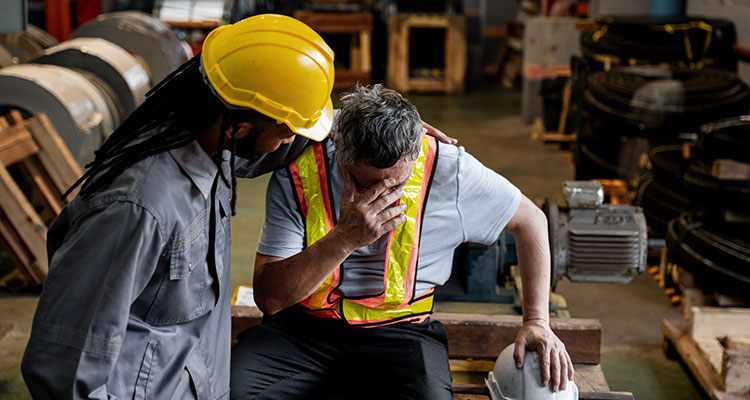
What workers' comp covers
Workers' compensation is a defined-benefit system. It provides specific, limited payments for certain types of losses. Your workers' comp benefits are typically limited to a few specific categories. This system provides a baseline of support but does not make you whole.
- Medical treatment: It covers the cost of all reasonable and necessary medical care for your work injury.
- Wage loss benefits: It pays a portion, usually two-thirds, of your average weekly wage while you are unable to work.
- Disability benefits: It provides payments for any permanent partial or total disability resulting from the injury.
This system provides essential support, but it leaves a significant gap.
The Missing Piece: Pain and Suffering
The most profound loss from a serious injury is often not financial. It is the physical pain, the emotional distress, and the loss of your ability to live your life as you did before.
The Minnesota workers' compensation system, as detailed by the Department of Labor and Industry (DLI), provides no compensation for these non-economic damages. A third-party liability claim is the only way to pursue compensation for this human cost.
Identifying the negligent third party
A third party is any person or company, other than your employer or a co-worker, whose carelessness caused your injury. Identifying this separate entity is the first and most important step in building a third-party claim. These claims are most common on worksites where multiple companies are present at the same time.
Construction site accidents
Construction sites are the classic setting for a multi-employer worksite. The general contractor, electricians, plumbers, crane operators, and delivery drivers may all work for different companies.
The negligence of one can easily injure an employee of another. A subcontractor leaving debris in a common walkway, causing an employee of a different company to trip and fall, is a clear third-party situation.
Defective machinery and product liability
Sometimes, the third party is not a person on the worksite at all. It is the distant manufacturer of a faulty piece of equipment. If a tool, a machine, or a piece of safety equipment malfunctions due to a design or manufacturing defect and injures you, you may have a product liability claim against that manufacturer. This is a form of third-party liability.
Negligent drivers on public roads
If your job requires you to drive, and another driver causes a car or truck accident that injures you, you have two claims. You have a workers' compensation claim because the injury happened in the course of your employment. You also have a third-party personal injury claim against the at-fault driver for their negligent driving.
The Process of a Third-Party Liability Claim
A third-party claim is a full-fledged personal injury lawsuit. It requires a deep investigation, a high standard of proof, and a legal strategy designed to overcome the defenses of a powerful corporate defendant.
Proving negligence
Unlike your no-fault workers' comp claim, a third-party claim requires you to prove that the other party was negligent. This means you must establish the four elements of a negligence claim: that the third party owed you a duty of care, they breached that duty, their breach caused your injury, and you suffered damages as a result.
The investigation process
A successful claim is built on a foundation of solid evidence. We launch an immediate investigation to preserve the proof of the third party's negligence before it can be lost or altered. This involves visiting the worksite, photographing the scene and the equipment involved, and interviewing all eyewitnesses, including your co-workers.
We also send a formal spoliation letter to the third-party company, demanding they preserve all relevant evidence, including maintenance logs, safety reports, and any internal video footage.
The workers' compensation insurer's interest
Your employer's workers' compensation insurance company has a strong financial interest in your third-party claim. They have the right to be reimbursed for the benefits they have paid to you out of any settlement or verdict you receive from the third party. This is called a subrogation interest. A skilled legal team works to negotiate this subrogation lien down, which can significantly increase the amount of money you ultimately put in your pocket.
Calculating the Full Value of Your Claim
The primary advantage of a third-party claim is that it allows you to pursue compensation for all of your losses, not just the limited benefits offered by workers' comp.
A third-party claim seeks compensation for a wide range of damages. We work to document every loss you have suffered.
- Full economic damages: This includes all of your medical bills and the full amount of your lost wages, not just the two-thirds portion paid by workers' comp. It also includes any future lost earning capacity if you are unable to return to your previous line of work.
- Non-economic damages: This is the compensation for your human losses. A legal professional will build a case to show the full extent of your physical pain, your emotional distress, and the loss of quality of life you have suffered. This is often the most significant part of a third-party recovery.
The legal deadlines in Minnesota and Wisconsin are also important. You must file a third-party personal injury lawsuit within the state's statute of limitations. Minnesota generally gives you six years from the date of the injury (Minnesota Statute § 541.05). Wisconsin's deadline is three years.
A Record of Fighting for Injured Workers
Tyroler Leonard Injury Law has a history of standing up for individuals harmed by the negligence of others, including in complex workplace scenarios. We prepare every case for a tough fight and have the experience to take on large corporate defendants and their insurance carriers.
Our past results show our commitment to our clients:
- $2,000,000 for a client who suffered a head injury in a semi-truck accident.
- $725,000 for a client injured in a Minnesota car accident.
- $275,000 for a client who was injured in a slip and fall due to a property hazard.
Past results do not predict future outcomes. All results are gross recoveries before fees, costs, and medical bills are deducted. We bring this same level of dedication and preparation to every third-party liability case we handle.
An Algorithm Won't Investigate Your Worksite
An artificial intelligence tool can give you general information, but it cannot visit a construction site to interview witnesses or analyze the complex contractual relationships between a general contractor and its subs. It does not know the nuances of Minnesota's subrogation laws.
Using an AI for legal guidance in a third-party liability case may cause you to make significant errors. You should always consult with a qualified personal injury attorney who can build a case based on real-world investigation.
Frequently Asked Questions About Third-Party Claims
Can I sue a co-worker who injured me?
Generally, no. The workers' compensation system provides immunity not only to your employer but also to your fellow employees. A third-party claim must be against a separate person or company.
The third-party company is blaming my employer for the accident. How does that affect my case?
This is a common defense tactic. The third party will try to argue that your own employer's negligence was the true cause of your injury. While you cannot sue your employer directly, their fault can be considered by a jury when allocating blame. This can be a complex legal issue that requires a skilled attorney to manage.
Do I have to pay my workers' comp insurer back from my settlement?
Yes, your employer's workers' compensation carrier has a legal right to be reimbursed for the benefits they paid on your behalf. This is called a subrogation lien. However, a personal injury attorney can often negotiate with the workers' comp carrier to reduce the amount of their lien, which increases your net recovery.
What if I was an independent contractor, not an employee?
If you were a true independent contractor, you are likely not eligible for workers' compensation benefits at all. In that case, a personal injury lawsuit against any negligent party, including the company that hired you, is your primary and only path to recovery.
Your Path to a Full Recovery

You deserve compensation from every party whose negligence contributed to your harm. A third-party liability claim is a way to secure the full and fair justice that the workers' compensation system alone cannot provide.
The attorneys at Tyroler Leonard Injury Law have the experience to investigate and pursue these complex cases. We will manage the deep investigation, handle the complex interplay with the workers' compensation system, and fight to hold all at-fault parties fully accountable for the harm they have caused.