The air in a warehouse is a constant hum of activity: the beep of machinery in reverse, the rumble of pallets, the shouts of a busy crew. A forklift is a part of that normal background noise, a workhorse of modern industry. But a split second can turn that powerful machine into an instrument of catastrophic harm.
A careless turn, a dropped load, or a mechanical failure can leave a worker with devastating, life-altering injuries. Now you are home, unable to work, facing a long and painful recovery. You know what happened, but the question is why.
The answer often lies in a chain of failures, from forklift accidents caused by operator error to the systemic safety failures that point directly to employer negligence.
The blueprint for your claim:
- Forklift accident claims are complex. They can involve your direct employer, a different company on the worksite (a third party), or even the forklift's manufacturer.
- The Occupational Safety and Health Administration (OSHA) sets strict standards for forklift operation, training, and maintenance. A violation of these standards is powerful evidence of negligence.
- Your primary path for benefits is through the workers’ compensation system. However, if a separate company or person caused your injury, you may have a second, additional third-party claim for personal injury damages.
- Preserving evidence, including the forklift itself and any surveillance footage, is an urgent priority. This proof is essential for showing exactly how the safety failure occurred.
The Unique Dangers of Forklifts
A forklift is not a car. It is a heavy, powerful, and often unstable piece of industrial machinery that poses unique risks in a workplace. Its design and function create inherent dangers that require a high level of training and diligence to manage safely.
Crushing force and weight
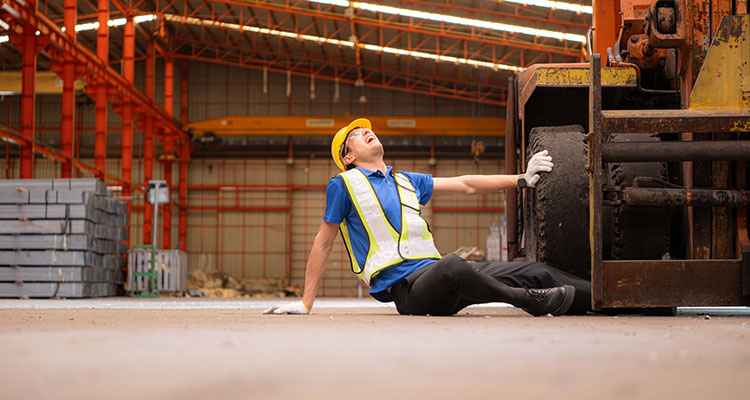
A standard warehouse forklift can weigh 9,000 pounds, three times the weight of a typical passenger car. Even a low-speed collision can result in immense crushing force. Pedestrians who are pinned between a forklift and a wall or racking system often suffer catastrophic internal injuries, amputations, and complex fractures.
Instability and rollover risks
Forklifts are counterbalanced to lift heavy loads, but this design also makes them top-heavy and prone to tipping over. A sharp turn, an uneven surface, or an improperly balanced load can cause a forklift to roll, crushing the operator or anyone standing nearby.
Significant blind spots
The design of a forklift, with its large mast and the load carried in front, creates significant blind spots for the operator. A driver who is not properly trained to look around the load, use mirrors, and sound the horn at intersections can easily strike a pedestrian they never even saw.
Establishing Negligence: Operator Error
Many forklift accidents are the direct result of a driver’s careless actions. An operator who ignores their training or operates the machine recklessly puts everyone around them in danger. An investigation into the operator's conduct is a key part of determining liability.
A forklift operator’s carelessness can take many different forms. We investigate to find evidence of these specific failures.
- Driving at an excessive speed for the conditions in the warehouse.
- Failing to sound the horn at intersections or when coming around blind corners.
- Attempting to lift a load that is too heavy or improperly secured.
- Driving with an elevated load that obstructs their view.
- Allowing unauthorized personnel to ride on the forks or in the cab.
These are not simple mistakes. They are violations of basic safety rules that every certified operator should know. Witness testimony and video evidence are powerful tools for proving this type of negligent operation.
Proving Employer Negligence
While an operator’s mistake may be the immediate cause of a crash, the ultimate responsibility often rests with the employer. Companies have a legal duty to create a safe work environment, and a failure to do so is a direct act of negligence.
The legal duty of an employer
Every employer has a legal and moral obligation to protect its workers from foreseeable harm. This is known as a duty of care. The Occupational Safety and Health Administration (OSHA), a federal agency, also defines this duty. OSHA's General Duty Clause requires employers to provide a workplace free from recognized hazards that are causing or are likely to cause death or serious physical harm.
A company that ignores a forklift with failing brakes or an operator with a history of reckless driving breaches that duty.
Failure to provide adequate training
OSHA has very specific and mandatory training requirements for all forklift operators. An employer cannot simply let any employee hop on a forklift. They must provide a comprehensive training program that includes formal instruction, practical hands-on training, and an evaluation of the operator's performance. A company that cuts corners on this training or fails to certify its operators is acting negligently.
Negligent maintenance of equipment
An employer must ensure that its equipment is in safe, working order. A forklift is a complex machine that requires regular inspection and maintenance. A failure to maintain a forklift can lead to a catastrophic mechanical failure.
An investigation often involves a formal demand for the company’s maintenance and repair logs, which can show a pattern of neglect.
Ignoring a history of unsafe practices
A single accident is often the result of a larger, ongoing culture of unsafe practices. If a company has a history of prior accidents, near misses, or safety citations from OSHA but has done nothing to correct the problems, this is powerful evidence of systemic negligence. This shows a conscious disregard for worker safety in favor of speed and profit.
The Legal Path Forward: Workers' Comp and Third-Party Claims
A forklift injury at work opens two potential legal paths.
Workers' compensation
Because the injury happened on the job, your primary claim is for workers’ compensation benefits from your employer. This is a no-fault system that provides payment for your medical bills and a portion of your lost wages. You do not need to prove your employer was negligent to receive these benefits.
A third-party liability lawsuit
The workers' compensation system prevents you from suing your own employer or a co-worker. However, if the negligence of a separate company or person caused your injury, you can file a third-party liability lawsuit. This is a separate personal injury claim.
It allows you to pursue compensation for your pain and suffering and the full amount of your lost wages. A third-party claim could be filed against several different entities. Your case may involve one or more of these negligent parties.
- A different subcontractor on a construction site whose employee carelessly struck you.
- The manufacturer of the forklift, if a mechanical defect caused the accident.
- An outside maintenance company that performed a faulty repair on the forklift.
- The driver of a delivery truck from another company that hit you in the loading dock.
An investigation works to identify every potential third party. This process ensures you can pursue all available sources of compensation.
A Record of Fighting for Injured Workers
Tyroler Leonard Injury Law has a history of standing up for individuals harmed by the negligence of others, including in complex workplace scenarios. We prepare every case for a tough fight and have the experience to successfully tackle large corporate defendants and their insurance carriers.
Our past results show our commitment to our clients:
- $2,000,000 for a client who suffered a head injury in a semi-truck accident.
- $725,000 for a client injured in a Minnesota car accident.
- $275,000 for a client who was injured in a slip and fall due to a property hazard.
Past results do not predict future outcomes. All results are gross recoveries before fees, costs, and medical bills are deducted. We bring this same level of dedication and preparation to every third-party liability case we handle.
An Algorithm Won't Investigate a Faulty Forklift
An artificial intelligence tool can give you general information, but it cannot inspect a forklift's maintenance logs or analyze a company's safety training records. It does not know the nuances of OSHA regulations or how to prove a third-party liability claim in Minnesota.
Using an AI for legal guidance in a complex workplace accident case may cause you to make significant errors. You should always consult with a qualified personal injury attorney who can build a case based on a real-world investigation.
Frequently Asked Questions About Forklift Accidents
What if I was the one operating the forklift and it malfunctioned?
You may have a product liability claim against the manufacturer if you were injured because the forklift itself was defective. A defect could be failed brakes, an unstable design, or a missing safety guard. This is a type of third-party claim. You would still receive workers' compensation benefits from your employer while pursuing this separate lawsuit against the manufacturer.
Can my employer fire me for filing a workers' compensation claim?
No. Minnesota law makes it illegal for an employer to retaliate against an employee for filing a good-faith claim for workers' compensation benefits. This includes firing, demoting, or otherwise discriminating against you.
The accident happened on a busy loading dock with several companies present. How do I know who is at fault?
This is a common and complex situation. A thorough investigation is required to untangle the relationships between the different companies and to determine whose employee was responsible. This involves reviewing contracts, interviewing witnesses from all companies, and analyzing the specific work duties of everyone present at the time of the accident.
What is OSHA's process after a serious workplace accident?
The employer must report any accident that results in a fatality or the in-patient hospitalization of an employee to OSHA. OSHA will then often open its own investigation to determine if any federal safety standards were violated. The findings of this government investigation can be powerful evidence in your civil personal injury claim.
Building Your Case for Recovery

A forklift accident can leave you with a lifetime of challenges. You deserve a legal team that will uncover the truth and fight for the full compensation you need to rebuild your life.
The attorneys at Tyroler Leonard Injury Law have the experience to handle these complex workplace accident claims. We will manage the deep investigation, handle the interplay with the workers' compensation system, and fight to hold all negligent parties fully accountable for their actions.